
Legal Due Diligence on Chinese Companies
Handled directly by a China-based legal team.
China due diligence helps an overseas business verify the Chinese company it plans to sign with, pay, invest in or appoint for a significant transaction. In practice, the review can identify legal-entity, ownership, litigation, enforcement, licensing and payment risks within an agreed scope, then explain what those findings mean for the decision in front of you.
Direct communication
Speak directly with the China-based legal team handling the review.
China-based review
Work with professionals who read Chinese legal and transaction materials in context.
Clear conclusions
Understand what the findings mean for the decision in front of you.
Efficient process
Avoid unnecessary referrals, repeated explanations, and cross-border travel.
START WITH THE DECISION
Tell us which company you are reviewing and what decision you need to make.
WHY A CHINA-BASED LEGAL TEAM
Local facts become useful only when they are interpreted in the context of Chinese law and business practice.
When a foreign business enters into a China-facing transaction, someone ultimately needs to address the issues on the ground. For this reason, a matter involving a Chinese company, Chinese legal documents, regulatory and court records, or verification with local personnel requires a team that understands Chinese law, the local business environment, and Chinese-language materials.
China-based execution
We read Chinese company-registration, court, regulatory, and transaction materials and understand their significance under Chinese law and local business practice.
Transaction-led scope
We design the review around the decision you need to make instead of applying the same checklist mechanically.
International-business reporting
We explain facts, legal risks, source limitations, and next steps in clear business language.
CHINA DUE DILIGENCE EXPLAINED
What Is China Due Diligence?
China due diligence is a structured review of a company registered in China and the facts that matter to a proposed transaction. Depending on the scope, it may combine company-registration information, Chinese-language public records, documents supplied by the parties, and legal analysis of ownership, authority, litigation, enforcement, licences, payment arrangements and other material risks.
Therefore, the objective is not merely to confirm that a company exists. It is to identify the exact legal entity, understand which parties will sign, invoice, receive payment and perform the contract, and explain what the available evidence means for the decision to sign, pay, invest or proceed.
Company Check vs. Legal Due Diligence
A China Company Check is often suitable when the immediate question is whether a company is registered and what its foundational public records show. By contrast, legal due diligence goes further when the findings must be assessed against transaction documents, payment structures, contractual rights or a significant commercial decision.
| Item | Company Check | Legal Due Diligence |
|---|---|---|
| Legal identity and registration | Included | Included and assessed in the transaction context |
| Shareholders and legal representative | Included | Included, with further ownership or authority analysis where relevant |
| Litigation, enforcement and basic risk indicators | Public-record review | Public-record review plus analysis of material findings |
| Transaction documents | Limited | Detailed review depending on the agreed scope |
| Contract and payment implications | Limited | Transaction-specific legal analysis |
| On-site or expanded workstreams | Not part of a standard check | Available where feasible and agreed |
A company check is therefore not a full transaction-level legal due diligence review. The appropriate route depends on the value, complexity and consequences of the proposed transaction.
What Can China Due Diligence Cover?
Depending on the agreed scope, the review may cover:
- the registered Chinese legal name and Unified Social Credit Code;
- current company status, registered address and significant registration changes;
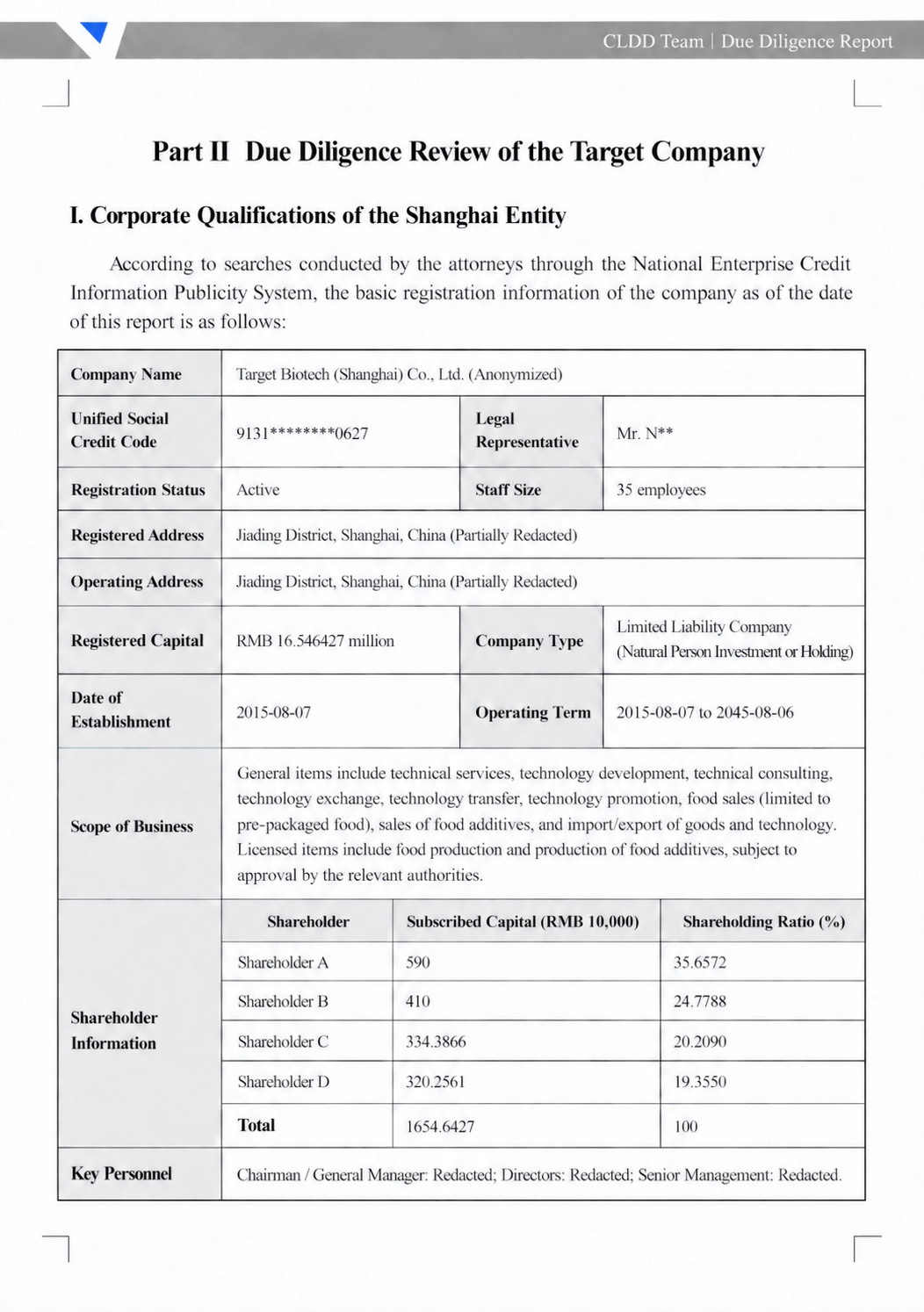
- shareholders, legal representative, registered capital and business scope;
- licences or qualifications where relevant and publicly verifiable;
- administrative penalties, abnormal-operation records and other public risk indicators;
- publicly available litigation and enforcement records;
- the contract counterparty, invoice issuer, payment entity and receiving bank-account holder;
- transaction documents, ownership questions and other specific concerns included in the engagement.
However, not every source or record will be available in every matter. For practical preparation, see our supplier due diligence checklist and legal due diligence checklist.
TWO LEGAL DUE DILIGENCE ROUTES
Choose the Right Due Diligence Scope
In practice, choose a defined online legal review for foundational public-record questions, or a tailored scope when the transaction requires deeper legal analysis or on-site work.
DEFINED-SCOPE REVIEW
Online Legal Due Diligence
Starting from USD 990
For example, this route is designed for businesses that want a structured review of a Chinese company’s legal identity, ownership, publicly available litigation and enforcement records, administrative penalties, regulatory licences, and other foundational risk indicators.
- Defined scope
- Fixed fee confirmed after intake
- Clear estimated delivery date
TRANSACTION-SPECIFIC REVIEW
Tailored Legal Due Diligence (On-site)
Fees confirmed after scope review
By contrast, this route is designed for matters that require further legal review of financial or payment materials, assets, key contracts, regulatory licences, on-site circumstances, management explanations, or specific warning signs.
- Objectives and materials reviewed first
- Feasibility and team confirmed
- Scope, timing, and fees agreed in writing
FROM SCOPE TO DECISION
1.How the China Due Diligence Process Works
Define the Entity and Review Scope
- Identify the Chinese legal entity. First, start with the Chinese registered name, Unified Social Credit Code and available business-licence information.
- Define the transaction and review scope. Next, clarify whether the decision concerns payment, a supply relationship, distribution, investment, acquisition, licensing or another material transaction.
Review Records and Report the Findings
- Search relevant corporate and public records. Then, select sources according to the entity, industry, location and questions presented.
- Review documents and risk indicators. In addition, compare public information with contracts, invoices, payment instructions, licences and other available materials.
- Analyze material findings. At the same time, distinguish discrepancies that have a reasonable explanation from matters requiring evidence, contractual protection or a change in transaction structure.
- Prepare a written report. Finally, explain the records reviewed, key findings, limitations, unresolved questions and practical next steps.
This is not a fixed legal procedure. Therefore, the scope and sequence depend on the type of transaction, the information available and the decision the overseas business needs to make.
2.What Is Included in a China Due Diligence Report?
A report may address company identity, registration status, ownership, the legal representative, capital information, business scope, litigation, enforcement, administrative risk, key discrepancies, risk indicators and practical observations. In addition, it should identify important source limitations and questions that could not be resolved from the available materials.
However, the contents differ by engagement. A Company Check Report focuses on foundational corporate and public-record information. By contrast, a full Legal Due Diligence Report may add transaction documents, contractual implications, payment arrangements, ownership or control issues, regulatory questions and other workstreams defined for the specific matter.
3.What Public Records Cannot Prove
Company-registration records do not independently prove current production capacity, available machinery, staffing levels or product quality. Therefore, those questions may require documents, inspections, testing or other transaction-specific verification.
A registered company record does not by itself establish why another entity is entitled to receive payment. Where the bank-account holder differs from the contracting party, the relationship, authorization and allocation of responsibility should be verified before funds are transferred.
However, public shareholding records are important but may not answer every question about actual control, related parties or arrangements outside the available record. As a result, additional documents and explanations may be needed.
The existence of a company does not establish that it can or will perform a particular contract. In addition, some liabilities, commercial relationships, operational problems and contractual risks may not appear in public databases. Therefore, due diligence reduces information gaps within an agreed scope; it cannot guarantee future performance or identify every risk.
4.When Is Additional Legal Review Needed?
A basic company check may be proportionate for an initial identity or registration question. By contrast, additional legal due diligence is more likely to be appropriate where the transaction involves a significant payment, long-term supply agreement, exclusivity, distribution appointment, investment, acquisition, intellectual-property licence, third-party payment, unusual ownership structure, conflicting corporate information or important contract documents.
For this reason, before choosing the scope, first verify the Chinese company before signing or payment. In addition, if the main concern is how contractual obligations, payment, acceptance, intellectual property or dispute terms allocate risk, a separate contract review may also be appropriate.
ANONYMISED MATTERS
Legal due diligence on Chinese companies in real business transactions.
In practice, each matter is organised around the commercial context, the material finding, and the decision that followed.
CASE STUDY 01
Checking the correct transaction entity before payment
Context
An overseas buyer was preparing a substantial advance payment.
Finding
However, the contracting entity, invoicing entity, and proposed payment recipient were not the same company, and the relationship between them was not clearly documented.
Decision
As a result, the buyer paused payment, requested written evidence of the entity relationship, and revised the contract and payment instructions before proceeding.
CASE STUDY 02
Confirming whether a supplier has genuine operating capacity
Context
A supplier presented itself as the manufacturer.
Finding
Registration records, affiliated-company information, the client’s documents, and a lawfully agreed on-site verification indicated that production was carried out through a related or third-party facility.
Decision
As a result, the buyer required clearer manufacturing responsibilities, inspection rights, and staged payment conditions.
FREQUENTLY ASKED QUESTIONS
Five questions to clarify the scope before you proceed.
For this reason, the answers below explain the practical differences, boundaries, and timing of the two legal due diligence routes.
What is the difference between Online Legal Due Diligence and Tailored Legal Due Diligence?
Online Legal Due Diligence follows a defined scope and focuses on the Chinese legal entity and lawfully accessible public records. By contrast, Tailored Legal Due Diligence is designed around a specific transaction and may add legal review of financial or tax materials, assets, contracts, regulatory licences, on-site verification, interviews, or other focused workstreams.
Will Online Legal Due Diligence show me the company’s complete financial position?
No. However, public information may provide certain operating and risk indicators, but it is not an audit or full financial due diligence. Therefore, if you need legal review of financial statements, tax materials, funds flows, or assets, we must first assess the available documents, the legal scope, and what can be verified reliably.
Can you visit the company or factory?
You may submit the request. In practice, we will assess feasibility based on the location, purpose of the matter, cooperation from the target company, safety considerations, and legal boundaries, and then confirm the scope, timing, and fee separately.
How long will it take to receive the report?
The estimated delivery time for Online Legal Due Diligence is 5 business days after the engagement, payment, target entity, and sufficient materials are confirmed. By contrast, timing for a tailored matter depends on the agreed scope, available materials, and cooperation from relevant parties. In addition, urgent matters are subject to a separate feasibility review.
Can you guarantee that every risk will be identified?
No. Due diligence is limited by the available sources, completeness of the materials, timing, agreed scope, and cooperation from third parties. For this reason, the report will identify the sources reviewed, limitations, and unresolved questions, but it cannot guarantee the target company’s future operations or the outcome of the transaction.
Start by telling us what decision you need to make.
Use the form to share the Chinese company name, Unified Social Credit Code if known, transaction background, proposed payment or contract, relevant deadline, available materials, and the questions you most want answered. We will use that information to assess the appropriate review scope.