
Observation
Warning signs in Chinese company records are facts that require explanation and further evidence, not automatic proof of fraud. Repeated registration changes, abnormal-operation entries, capital inconsistencies, equity restrictions, enforcement cases or mismatched payment details can be material. Their meaning depends on timing, reason, recurrence, transaction value and whether the company provides credible primary documents.
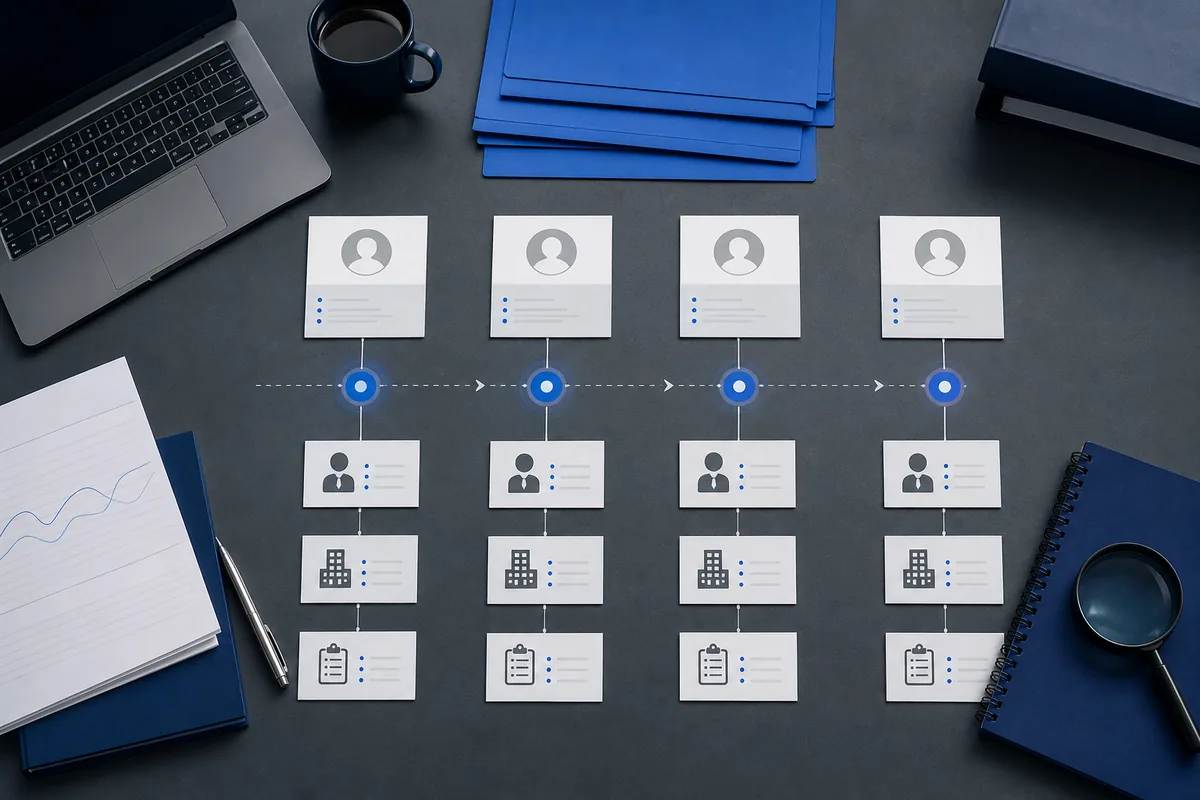
Read records as a timeline, not a snapshot
Begin with the exact registered Chinese name and unified social credit code. Save dated results from the National Enterprise Credit Information Publicity System. Compare the current profile with annual reports, change records, penalties, equity pledges and other disclosed information. Then align the timeline with negotiations, payment requests, management changes and the proposed transaction.
One change may be ordinary. Several changes close together—especially before a large order, investment or dispute—may point to a restructuring, transfer of control, relocation, regulatory problem or attempt to move business between entities. Ask what changed, why, who approved it and which entity now owns the assets and obligations.
1. Frequent changes in legal representative, shareholders, address or scope
A legal-representative change may follow normal leadership turnover. A shareholder transfer may reflect financing or group reorganization. An address change may be administrative. Risk rises when changes are frequent, unexplained or inconsistent with the company’s account of its history.
- Legal representative: establish whether authority, seals, bank controls and contract approvals changed at the same time.
- Shareholders: identify the buyer and seller, consideration, approvals, contribution obligations and any continued control arrangements.
- Address: compare the registered office, factory, warehouse, invoice address and actual operating site; investigate undeliverable addresses.
- Business scope: determine whether the company added a new activity just before offering it and whether separate licenses are required.
Request historical business licenses, articles of association, shareholder and board resolutions, equity-transfer documents, lease or property evidence, and authorization or seal-control records relevant to the period.
2. Abnormal-operation and serious-dishonesty entries
Under the Enterprise Information Publicity Interim Regulation, revised in 2024, a company may enter the list of enterprises with abnormal operations for failures such as not submitting required annual reports or not publicizing required information. The precise basis, listing date, corrective action and removal status matter. An old, corrected filing lapse differs from a current inability to contact the company at its registered address.
The market-regulation serious-illegal-and-dishonest list involves a different and more serious framework. Do not conflate it with an ordinary abnormal-operation entry. Obtain the underlying decision, grounds, current status and any credit-repair or removal record. Also search sector regulators, because not all material licensing or compliance information is contained in one database.
3. Misunderstanding registered, subscribed and paid-in capital
Registered capital is not a bank balance and does not establish solvency. For a limited liability company, the record may include subscribed amounts to be contributed according to statutory, transitional and constitutional deadlines. Paid-in information may come from company disclosures and should be tested against contribution certificates, bank records, audit or verification documents and accounting treatment where material.
The Company Law revised by the National People’s Congress Standing Committee on 29 December 2023 took effect on 1 July 2024. It introduced important contribution and disclosure rules, while State Council transitional provisions address companies established before the new law. A large registered figure with little current contribution, an unusually long or recently changed deadline, or non-cash assets of uncertain value warrants deeper review—but not an automatic conclusion of misconduct.
4. Equity pledges, freezes and frequent transfers
An equity pledge may be ordinary financing, but it can affect control, enforcement exposure and closing mechanics. Identify the pledgor, pledgee, secured obligation, percentage, registration date and release requirements. A judicial freeze may restrict transfer and signal a dispute or enforcement proceeding; obtain the court, case reference, scope, duration and current status.
Frequent transfers can reflect investment rounds or internal reorganizations. Examine whether consideration was paid, taxes and approvals were handled, other shareholders waived rights, capital obligations followed the transfer and beneficial control changed. For an investment, reconcile the public record with the shareholder register, articles, financing agreements and representations from all relevant owners.
5. Litigation, compulsory enforcement and dishonesty information
Litigation should be analyzed by role, claim, amount, date, stage, outcome and relevance. A manufacturer that occasionally sues customers to collect invoices presents a different pattern from repeated product-quality claims, employee disputes or judgments for non-performance. Public judgment databases may not contain every case, and names must be matched carefully.
Enforcement information can be more urgent because it may show an unsatisfied effective instrument, asset-control measures or restrictions. The Supreme People’s Court’s China Enforcement Information Disclosure website provides official routes to search judgment debtors, dishonest judgment debtors and related enforcement information. Being a judgment debtor is not identical to being included on a dishonesty list; verify the exact category and current status.

6. Administrative penalties and license problems
Read the underlying penalty decision where available. Identify the regulator, conduct, legal basis, date, sanction, corrective order and whether the issue recurred. A modest historical fine can reveal a control weakness relevant to the new transaction, while a serious license revocation may prevent lawful performance.
Check the actual permit: holder, activity, premises, products, capacity, conditions and expiry. A license held by a parent or affiliate does not automatically cover the contracting company. A recently expired, suspended or narrowly scoped permit may require a condition before signing or closing.
7. Contracting and payment entities do not match the record
Compare the registered company with the entity named on the proposal, contract, company seal, invoice and bank account. Also identify the factory, exporter, intellectual-property owner and warranty provider. Mismatches sometimes reflect legitimate group or agency structures, but the legal chain must be documented.
High-risk examples include payment to a personal account, an unrelated offshore company, a recently substituted beneficiary or a company with no stated role. Ask for the commercial reason, agency or assignment agreement, invoice and tax treatment, corporate approvals and written confirmation from the contracting party. Do not release funds until identity and recourse are clear.
Where several of these signals appear together, you can order a fixed-price China company verification report ($129, delivered within 3 business days).
What to request after a warning sign appears
- Current and historical business licenses and articles of association.
- Shareholder registers, resolutions, equity-transfer and financing documents.
- Capital-contribution certificates, bank evidence and relevant audit records.
- Pledge releases, court preservation or freeze documents and case updates.
- Administrative decisions, rectification reports and credit-repair or removal notices.
- Current licenses, renewal filings, regulator correspondence and inspection reports.
- Premises leases, factory ownership or operating agreements.
- Bank-account ownership evidence and agreements explaining third-party payment.
- Material contracts, credit-support documents, insurance and dispute schedules.
How to decide whether the explanation is credible
- Match identities: confirm every document relates to the same Chinese entity and period.
- Check chronology: the explanation should fit registration, payment, dispute and operational dates.
- Prefer primary records: official decisions, signed corporate documents and bank evidence carry more weight than informal assurances.
- Test completeness: ask what contrary evidence would exist and whether it has been provided.
- Connect to the deal: decide whether the issue affects authority, performance, assets, licensing, payment or recovery.
- Choose a response: require documents, change the party, add security, stage payment, impose a condition, adjust price or stop.
Common misconceptions and limits
- “One adverse record proves fraud.” It does not. Context and primary documents are required.
- “No search result means no risk.” Databases have coverage, timing and identity limitations.
- “High registered capital means strong finances.” Capital figures require contribution and solvency analysis.
- “Removal erases the history.” Removal may show correction, but timing and cause can remain relevant.
- “The group will stand behind the contract.” Group affiliation does not automatically create binding parent support.
When a deeper Company Check is useful
Deeper review is appropriate when records contain several connected anomalies, when explanations are unsupported, or when the transaction involves advance payment, regulated products, valuable IP, exclusivity, long-term dependence or investment. Review should extend beyond public results to transaction documents, corporate records and, where justified, specialist checks.
For the full pre-signing sequence, read How to Verify a Chinese Company Before You Sign or Pay. Our China Company Check service can place record anomalies in transaction context. To share the company name, code and proposed deal, use the Contact page.
Official sources
- Enterprise Information Publicity Interim Regulation, State Administration for Market Regulation (promulgated by the State Council in 2014; revised under the State Council decision of 10 March 2024, effective 1 May 2024).
- Company Law of the People’s Republic of China, National Laws and Regulations Database (revised 29 December 2023; effective 1 July 2024; current status shown as effective).
- National Enterprise Credit Information Publicity System, official national market-entity information portal.
- Supreme People’s Court introduction to the China Enforcement Information Disclosure website.
This article is provided for general informational purposes only and does not constitute legal advice. The appropriate scope of review depends on the transaction, industry, available documents and specific risk factors.